
This road has been his daily commute for the past 30 years to his forest management company’s office.
As we turned the winding road he pointed out the window to the undulating hills, describing the path that the cyclone took through the forest in 2024. It was easy to see the path this force of nature took as there were large runs of clearing between stands of trees, re-designing the edge of the forest.
Ian then continued to share his observation of the condition of the remaining trees now exposed as the new forest edge. There were visible signs of fatigue and weakness. These trees were grey, thin, foliage-free, brittle, and in some cases falling over and creating pockets of debris. Ian explained that the cyclone removed the edge trees that once protected these inner trees against wind, and in extreme cases, fire. This results in yield lost as the inner trees are more susceptible to the elements and die off. As a forest manager, you then need to decide to harvest the remaining healthy forest before the weak pockets take over the whole section and replant new trees (most likely outcome), or, if the inner trees choose to adapt to the conditions and become edge trees they will give you a few more years before you harvest and replant (least likely outcome).
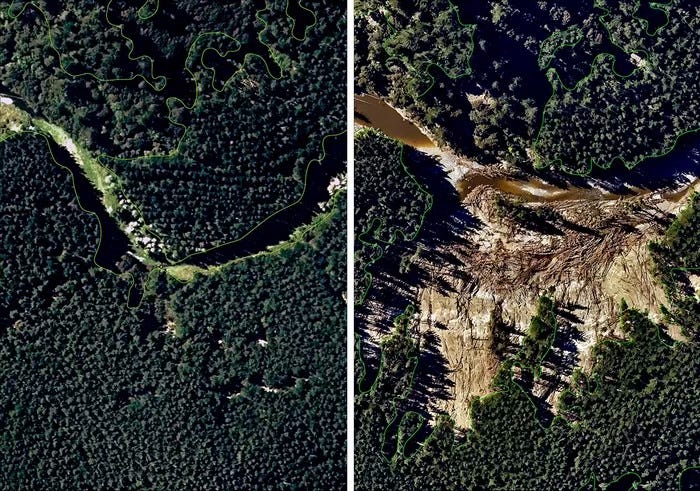
We have all experienced devastating disasters in our lives, projects, and businesses. Situations that blow through at a moments notice and take away our protection. Whether these are people, places, systems or processes, their absence cause us to loose our footing, create areas of debris and decay, and sometimes even fall down. Just as nature shows us so frequently, it doesn’t mean the show is over. It means we need to surrender to the cycle, harvest the healthy parts, and replant or restart. I think we can all agree that it is far easier to start from a clean slate than to adapt into something we were not conditioned for.
Notably, edge trees are the same species as the internal trees (this surprised me too). It is simply that when the edge trees are planted, they are located at the edge of the forest. “An edge tree doesn’t choose to become an edge tree, it adapts to the conditions”, Ian explained. Edge trees have bigger branches, are wider at their bases, have more foliage, and taper significantly in comparison to their inner tree neighbors. They do not have competition for resources. They perform a function of protection and are not a money maker like the long, straight, and less knotty inner tree.
There are so many dots to connect here it’s stretching my mind, but what I think is important to share is that the conditions we expose ourselves, our teams, and our businesses to matter and are varied. The conditions do not necessarily need to be pristine to serve their purpose, in fact some elements need harsher conditions to thrive while others require more tranquil conditions. It is our job as leaders to be aware of this and provide the support as required. Most importantly, whether you have team members on the edge providing governance, championing an idea, or standing up for a quiet colleague, they all matter and contribute to the greater purpose.
Edge trees are more than a passive protector. They serve as the transition between different habitats, playing a critical role in health and balance of ecosystems. I imagine these edge trees as people who are comfortable being uncomfortable. We need them. Sure they’re a little different in how they do things and maybe a bit blunt, but boy do they have impact! They are the ones who carve the pathway for connection to new resources, partnerships, and opportunities. They provide the environment for the inner trees to stand tall and add value. That sounds pretty indispensable to me!
I invite you to take a moment and reflect on your own experience:
- What/who are your ‘edge trees’ maintaining your ecosystem?
- What/who are your ‘inner trees’ yielding the greatest return?
- What habitats are you operating between?
- What changes would you make to your ecosystem now that you have this example?


